
Personality vs. Pathology
An Interview with psychologist Karina Schneidman

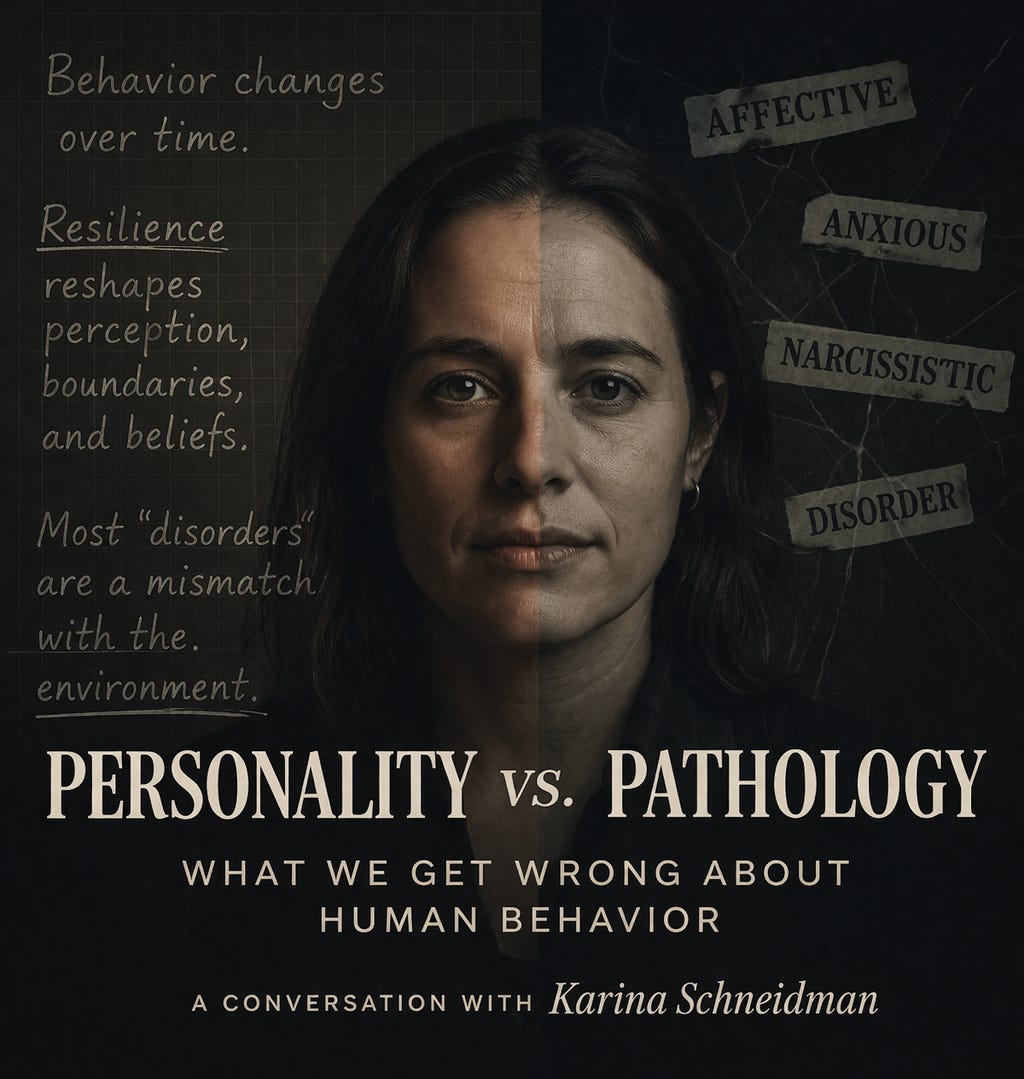
There’s a tension that keeps showing up in conversations about personality.
On one side, you have people trying to build frameworks. They want to measure, categorize, and map human behavior so it becomes predictable (or at least, they believe it’s already predictable and can be categorized). On the other side, you have practitioners—people actually working with real human beings—who see something far less stable. They see people change, adapt, contradict themselves, and evolve in ways that don’t always fit clean models.
That tension is where this conversation sits.
I recently had Michael Woudenberg on the podcast, and we talked through the usefulness of personality frameworks, including why they exist, what they clarify, and what happens when you throw them out. Frameworks, however, can also distort as much as they clarify.
That’s where Karina Schneidman MBA, MS-MFT comes in.
Karina has an MBA in Compliance and Operations as well as a Master of Behavioral Science in Marriage and Family Therapy and is board-certified in ADHD, brain health, wellness, and human health. She works with individuals, couples, and families, bringing a compassionate, practical, and relationship-centered approach. Her Substack is blunt, uncompromising, and fascinating.
And what she’s pointing to is this: Human behavior is not static—and she’s not wrong. It shifts with resilience, or environment and experience. When you try to freeze it into categories too quickly, you risk being wrong and misreading the person entirely.
At the same time, removing all structure creates a different problem. If everything is fluid, then nothing is identifiable. And when nothing is identifiable, pathology can hide in plain sight. Karina and Michael had a fascinating conversation in Substack Notes about this, and I wanted to dig into it. Karina was gracious enough to answer some questions for me.
In your exchange with Michael Woudenberg, one of the central tensions is this: he sees personality frameworks as useful tools for understanding human patterns, while you seem more cautious about how those frameworks reduce people. Where do personality frameworks genuinely illuminate a person, and where do they start distorting them? (I had him on the podcast recently, and we discussed the usefulness of personality typology; I want to give you an option to make your case as well.)
Michael and I have gone back and forth on this topic quite a bit, and believe it or not, I’m still not ready to land the plane on this one. One reason I’m hesitant to rely on tools that attempt to define human patterns is that I’ve witnessed what feel like incredible transformations in the people I work with. Their entire personality baseline can shift.
For example, imagine Mary takes a strengths assessment in her 30s. After years of life experience, she takes the same test again in her 40s and gets completely different results. Why does that happen? I’m still working through this, but I believe resilience plays a key role in how personality evolves over time. Resilience shapes a person’s perception of their capabilities, boundaries, and beliefs. Generally, I do not think that Michael is wrong, specifically, I think that there is so much more we don’t know, still. I’ve never relied on personality frameworks, but maybe my own personality won’t let me.
A lot of behavior that earlier generations would have described as temperament, character, or eccentricity now gets described using clinical language. What cultural shift do you think drove that change?
In my humble opinion, a lot of this language emerged alongside the rise of feminism. Having lived in three countries and six states across the United States, I’ve had the privilege of meeting and working with people from many different industries and cultural backgrounds. It sometimes seems to me that feminism brings with it a tendency to frame differences in behavior as illness, in an effort to justify or accommodate them.
America is a melting pot, with hundreds of cultural perspectives all trying to “read the room.” Different cultures interpret social cues and life transitions in very different ways, which makes it difficult to define what is “normal” behavior across contexts. At the same time, as modern psychology has evolved with more structured diagnostic frameworks like the DSM along with hyper increased mental health awareness and systems that often require formal diagnoses, there’s been a noticeable shove toward using clinical language to describe behaviors that earlier generations may have simply seen as personality or temperament. It seems that society is forgetting that being different isn’t a sickness or a disorder.
Much of my own work focuses on how individuals shape group dynamics and leadership environments. From your perspective as a psychologist, how do individual emotional patterns (things like fear, loneliness, or the need for control) scale up into the behavior of institutions and groups? Can unhealthy emotional dynamics at the individual level eventually shape entire organizations?
Having worked in business for 20 years before moving into behavioral health, I can tell you that leadership reflects attitude and attitude reflects leadership. Emotional contagion is not just addictive; it spreads like a mind virus, silently infecting individuals and rippling through entire teams. It’s much like the old saying: one bad apple spoils the bunch. Unchecked, unhealthy emotional dynamics can crack trust, stifle creativity, drain energy, and turn even high-performing groups into dysfunctional ones. The mood of one person can shift the tone of a meeting, the morale of a team, and ultimately the culture of an organization. We are animals, highly sensitive to external stimuli, and our brains are As much as I dislike overusing the word “trauma,” there is a layer of secondary trauma that affects our brains when we experience unfairness, injustice, rudeness, or emotional dysregulation.
As someone working with real people rather than theoretical models, how do you personally distinguish between a strong personality trait and an actual pathology?
I take my time with my clients and learn about their lives, habits, how they rationalize their decisions, and how often they use thinking models as opposed to emotional bandwidth to find solutions. Based on my observations and how they respond consistently across different aspects of their life, I make my professional assessment. I watch their facial expressions and body language and assess. It happens over time for me. The physical presentation and facial expressions are a map to their soul, and I take my time discovering who they are and if there is some pathology to bring up.
How often do you see behaviors labeled as disorders that are actually the result of a mismatch between a person and the environment they’re operating in?
This is the million-dollar question. In my work today, this is the case for over 90% of my current clientele. Clinical establishments focus too much on personal habits and traits, and not enough on the environment which is becoming increasingly detrimental to the type of beings we are and to what we need to succeed.
Modern workplaces, schools, and even therapy culture often reward certain personality styles while penalizing others. Which types of personalities do you see getting pathologized first?
Personalities that present as confident, driven, ambitious, curious and precocious tend to be pathologized first and heaviest. Men and boys are penalized for having any of these flexible traits and are immediately categorized.
What is the difference between emotional suppression and emotional regulation? How can someone be stoic without being emotionally disconnected?
The difference between emotional suppression and emotional regulation is situational awareness and self-agency. Typically, certain situations call for emotional expression, while others require suppression it isn’t a zero-sum game. As a mother, if I watch one of my kids get hurt, I do my best to hold it together because I understand they are watching my response to figure out what’s happening. For their sake and my own, I suppress my emotions when it won’t be helpful essentially, I’m reading the room. One of my client’s family members, whom I was also working with, passed away. I was very emotional with my client, and in my opinion, that was an example of appropriately regulated emotion. Each situation will call for our internal intuition to help us.
From a psychological perspective, how important is autonomy to human stability? What happens psychologically when people feel chronically controlled by schedules, authority structures, or systems they do not influence?
The most important weapon and coping mechanism we have in order to build resilience is self-awareness. All humans, from one perspective or another, are bogged down by schedules, authority, structures, and systems they can’t influence. This isn’t just true for humans it’s true for the entire planet. There is a rhythm to our lives, and it is up to us to figure out how to balance the things we don’t like with the things we do like. We adjust, make compromises, and find ways to reward ourselves with quality of life as opposed to quantity.
If a person has a job that is highly demanding with a lot of structure, then plan non-negotiable vacations. Buy a ticket somewhere or get in the car, go to a city, and fly by the seat of your pants. Give yourself the gift of being spontaneous. Balance and critical thinking skills are a win here, feelings do not pay bills so feeling controlled isn’t going to solve any long term complexities, actions and thinking always will.
Trauma can reshape behavior dramatically, but trauma responses, personality traits, and pathology are not the same thing. How do you separate those layers when you’re working with someone?
When I do trauma work, I use the resilience approach. Trauma work comes with “what if” anxiety and fear. I use resilience to re-route ideas, thoughts, and feelings; this helps break habits that formed after trauma, rationalize irrational fears by helping the client tweak the narrative from “I am a victim” to “I am a survivor,” and I explain how important it is not to get addicted to negative thoughts, because they do cause a chemical response that results in a full-body “high,” similar to the chemical high provoked by drugs.
If you were designing a healthier way for society to think about human differences (one that avoids flattening people into categories but still allows us to identify real pathology), what principles would that framework need to include?
Honestly, the only and most important framework I think we need is teaching people how to communicate. So many people listen just to respond, rely on emotion to drive their thoughts, and make assumptions based on societal standards, which ultimately devours the magic of a good conversation. Moving away from labels and focusing on the experiences we have with people is what should matter most labels don’t solve problems or help us grow.
Final question: What one thing do you wish people understood about human behavior?
Not to assume that human behavior is linear and stay open minded. Human behavior isn’t just the brain (the hard drive) it is also the mind (the software) and the mind is its own universe. We know so little, still.
Karina is describing patterns that consistently show up in how people think and relate to their world. We already know that as orientation, and we know it can and does change over time. If you don’t understand the internal landscape that someone is operating from, it’s hard to correctly read behavior. Her work sharpens that lens and offers a simplicity where a lot of people have added complex layers and weird labels. Most importantly, I think they’ve reduced accountability with those layers and labels.
That being said, Michael is also correct in that human behavior is not so incredibly unique that it cannot be categorized and its patterns studied, and I don’t see Karina as disagreeing with that.
Where this gets interesting for me is what happens afterward: once you see the pattern, what then? What do you do with it?
Insight doesn’t change outcomes; you can see the pattern all day, but if you do nothing about it, nothing changes. That’s true whether you’re observing yourself or someone else.
One of the implications for my work is that these things scale in a group. If you put five people in a group who have similar blind spots or unmet emotional needs, their patterns will start reinforcing each other.
Approval-seeking becomes groupthink.
Conflict avoidance becomes an inability or unwillingness to address issues.
Fusing one’s identity with the group or mission becomes fragility during correction and a refusal to hear feedback.
Once it gets to that point, the individual’s issue becomes a structural facet for the group. That puts the subject squarely in my arena, and it’s where I’m most interested.
Conclusion
Is Michael wrong, or is Karina wrong? I don’t think either of them is wrong at all; I think the topic is far more nuanced than that. I also think putting it all into a right/wrong box is both oversimplistic and sucks all the value out of the conversation, and continuing to have the discussions is what’s important.
Someday, I would LOVE to get them both on a podcast and do this in real time, because I think the quality of the discussion would be unreal. For now, however, let’s chew on this:
What if they’re both right? I think they are.
What if personality frameworks are helpful, and people overuse them? What if, in our quest to feel like we are the normal ones, we do apply pathologies to quirks? And is Karina right about feminism being the biggest influence surrounding overpathologizing personality?
I will be thinking on these ideas for a while.
Visit Karina at My 2 Cents.
I’m loving the dialogue and this is the essence of Mixed Mental Arts that I write about all the time namely, “grappling with complex problems in the octogon of life.” It’s not an argument except as we work through the issues without capitulation. As iron sharpens iron.
Autonomy is a stabilizer—but only when capacity is there to meet it.
Without it, people can feel controlled and disengage. With it, they can either step up or drift.
That’s the tension: stability needs structure, but people need enough agency to stay engaged.