
No, Humans Are Not Basically Good
Believing they are is incredibly dangerous.

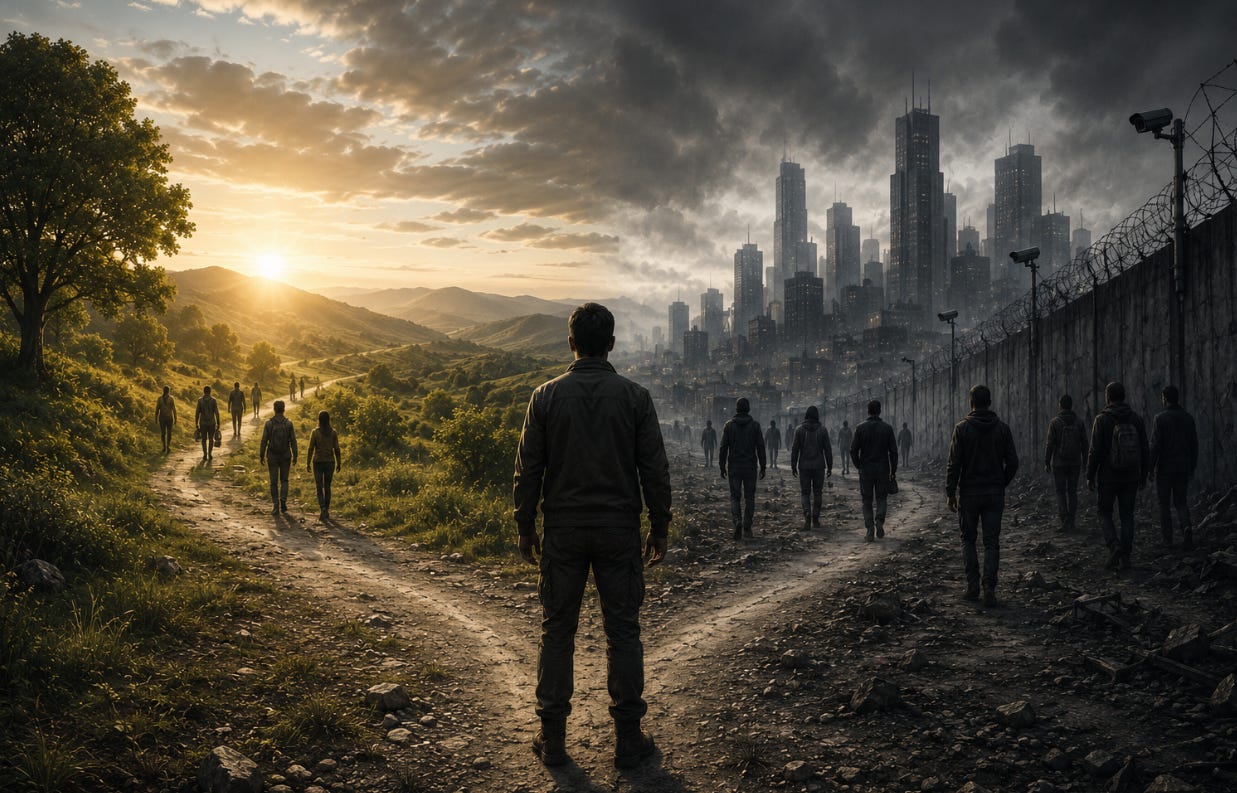
Humans are basically good.
That sentence is believed by a lot of people because it sounds compassionate and enlightened. It makes the speaker sound morally elevated.
What if it’s not true?
Interestingly enough, every serious human system ever created assumes exactly the opposite. In fact, most human systems exist because of that opposite assumption. Let’s look at a very short list of things. Why do we have locks on our doors? Passwords? Audits? Contracts? Courts? Vetting? Encryption? Checks and balances? The list is staggering.
If people are basically good, why does civilization need so many safeguards against human behavior? If we are honest with ourselves, it’s an uncomfortable answer. We already know that humans drift, and that the drift is systemic.
We drift toward self-interest, comfort, rationalization, tribal loyalty over truth, status protection, emotional convenience, and even self-deception when reality threatens our constructed identity. If the conditions are right, we drift into violence, hate, and levels of depraved creativity, coming up with ways to harm others that are staggering in their intricacy and evil. This propensity is often multiplied in groups; there’s a reason why the phrase “mob mentality” has a negative connotation.
This isn’t to say that humans are not capable of extraordinary good. Things like sacrifice, courage, mercy, integrity, and heroism are also found in humanity. The problem is that this is not the default, and we all know it. They aren’t automatic traits; they require intentionality and discipline forged over time.
In fact, we understand this so intrinsically that we give awards for it. We choose to set apart certain people for recognition when they do extraordinary acts of goodness because we know that it is not normal behavior. When we say, “Let’s all honor this person who went above and beyond,” what we are really saying is, “This person made a conscious choice to operate outside of the normal ranges of human behavior.”
What’s the normal range? Self-interest. Default human behavior drifts toward self unless consciously disciplined otherwise. It’s why we have to choose to be physically fit, but we never have to choose to be lazy. We have to choose to love our spouses with actions and put work into our relationships; we never have to choose to be sloppy about how we show up.
When someone in the public eye gets caught doing something wrong, such as misconduct, theft, lying, etc., do you naturally assume that they will repent of it and make it right? Or do you assume they will reframe it, dodge accountability, or seek to vilify their victims?
Why?
Because you already know what the default is. If they actually own it, accept consequences, and attempt to make restitution, we are often so surprised that we don’t even believe that they’re serious or sincere. Because we already know what the default is.
The Uncomfortable Truth
Human beings are not naturally stable creatures. Human beings do not naturally stabilize toward discipline, morality, or truth any more than neglected systems naturally stabilize toward order. If we coast through our lives, we will not drift toward fitness, discipline, and stability. There is a reason why parents have to provide structure for their children, and why children without it grow up to be problematic adults.
We do not drift toward the positive.
People often imagine perception as a passive thing: You observe reality and then respond rationally. That’s not how humans actually work, and clearing that misconception is one of the central themes of my work on orientation.
Humans are interpretive creatures. We construct maps of reality through everything from identity to emotion to attachment, incentives, trauma, social belonging, fear, ego protection, and even narrative protection. This is what is called our orientation. Once the map is formed, we instinctively defend it. In fact, we will defend our beliefs against reality itself. Especially then.
This is why reorienting requires discipline, because if left to your own devices, you will never change your map unless forced to—and even then, some folks still don’t. This is why highly intelligent, capable people can be capable of astonishing levels of distortion if their identity is threatened.
What the Distortion Leads To
History is full of examples of supposedly “normal” people engaging in shocking forms of evil. While some people, such as Jeffrey Dahmer, were well aware of their evil, others genuinely believed they were doing good. Put bluntly, many of the atrocities in human history were committed by people who believed they were justified.
One of the most dangerous human tendencies is when we believe we are immune to corruption. The moment we believe that about ourselves, we are exponentially more vulnerable to it. The second we believe that we are “basically good” and will choose the right course of action by default, we are that much more likely to be swayed into evil while thinking we are one of the good guys.
Entire populations have rationalized cruelty, genocide, mass rape, torture, and a host of other horrors simply because they thought the end goal was a good one.
You might be assuming that this is a question of nature vs. nurture, but I think it’s deeper than that. For instance, in Philip Zimbardo’s now-infamous Stanford Prison Experiment, some of the questions posed for the experiment were things like:
“What happens when you put good people in an evil place? Does humanity win over evil, or does evil triumph?”
I would argue that they were starting from a faulty premise, because people are not basically good. Zimbardo himself was shocked by the results:
Our planned two-week investigation into the psychology of prison life had to be ended after only six days because of what the situation was doing to the college students who participated. In only a few days, our guards became sadistic and our prisoners became depressed and showed signs of extreme stress.
We also cannot claim that they somehow chose personality outliers. Zimbardo points out that by all accounts, the participants were completely “normal.”
More than 70 applicants answered our ad and were given diagnostic interviews and personality tests to eliminate candidates with psychological problems, medical disabilities, or a history of crime or drug abuse. Ultimately, we were left with a sample of 24 college students from the U.S. and Canada who happened to be in the Stanford area and wanted to earn $15/day by participating in a study. On all dimensions that we were able to test or observe, they reacted normally.
Our study of prison life began, then, with an average group of healthy, intelligent, middle-class males. [emphasis added]
So what happened? While it’s often posited that the environment made them that way, that removes agency. We cannot simultaneously have agency and yet be completely subject to our environment. If environments can be wholly responsible for our chosen actions, then how do we explain combat veterans who are capable of great violence in theater, and still take the time, even when deployed, to be caring, gracious, attentive partners and parents?
The answer is intentional use of agency. Maybe they choose to seek healing when they come home. Maybe they choose to be involved in a faith tradition. Maybe they choose to ground themselves in literature, hobbies, or other pursuits. Regardless of how they get there, they are using their agency to make deliberate choices, and those choices are outside of the default.
If they did not make these choices, who would they be? If you did not make deliberate choices to be disciplined and intentional in your daily life, who would you be?
Milgram’s Experiment and Its Implications
In 1963, Stanley Milgram wanted to know why so many regular Germans went along with the atrocities of Nazism. How could normal people be guilty of such horrors? Certainly, Americans would react differently.
Milgram framed the question directly:
“Could it be that Eichmann and his million accomplices in the Holocaust were just following orders? Could we call them all accomplices?”
His experiment sought to measure how far ordinary people would go in harming another person if instructed to do so by a legitimate authority figure. Participants believed they were administering increasingly severe electric shocks to another human being as part of a learning experiment.
Before conducting his experiment, Milgram surveyed psychiatrists who predicted only 0.1% of participants would administer maximum shocks, expecting most would refuse between 150-300 volts once hearing the learner’s protests or heart concerns.
They were wrong.
65% (two-thirds) of participants (i.e., teachers) continued to the highest level of 450 volts.
100% of the participants continued at least to 300 volts.
A total of 14 “defiant” participants stopped before reaching the highest levels (5 at 300v, 4 at 315v, 2 at 330v, and 1 each at 345v, 360v, and 375v).
Milgram showed that ordinary people will often violate their own conscience if enough structural pressure is applied and moral responsibility becomes psychologically diffused. They were ordinary people operating inside a structure that shifted responsibility upward and gave them permission to drift.
What Does It All Mean?
The most dangerous people are the ones who believe themselves incapable of becoming evil. The people most vulnerable to corruption are those who view themselves as incorruptible.
Human beings are remarkably skilled at rationalizing almost anything once identity, fear, belonging, comfort, status, or even perceived righteousness become involved. If the right driver is leveraged, people can acclimate themselves to cruelty while continuing to believe they are moral; in fact, they can continue to believe they are more moral than others. That perceived superiority is the beginning of dehumanizing our enemies into categories. Once they’re categorized instead of fellow humans, it becomes dramatically easier to rationalize cruelty.
This is not an argument against justice, punishment, or moral accountability. Societies require all three. The danger emerges when justice mutates into dehumanization. The moment people stop seeing others as human beings and begin seeing them only as categories, abstractions, enemies, or moral contaminants, cruelty becomes dramatically easier to rationalize.
We are capable of good acts, certainly, but goodness is not our default state because we drift. Discipline, humility, accountability, truth, repentance, structure, moral courage…these things matter more than we can possibly imagine, and I would argue that we cannot engage with them fully unless we are willing to admit that we need to engage with them deliberately. A culture that insists human beings are naturally good will eventually begin dismantling the very structures designed to restrain human drift.
If you do not consciously orient yourself toward truth, restraint, and moral responsibility, there will always be a structure that is willing to give you permission to drift elsewhere—and that “elsewhere” is never somewhere good.
This is one of the more honest pieces I've read on the subject. Most people flinch at where you go here, and you don't. I agree with your central claim: goodness is not a default, and cultures that pretend otherwise tend to dismantle the structures that keep drift in check.
A few places where I'd push gently:
The piece treats choice as more binary than I think it is. Most human choices aren't between good and bad options. They're between constrained, often bad options within systems the person didn't design. I'd read Milgram and Zimbardo slightly differently from you. I think they demonstrate less about our default nature and more about how completely situational architecture can collapse the range of options a person perceives as available. That may be the more troubling finding.
The combat veteran example is interesting because many of those veterans come home changed in ways they didn't choose and can't fully undo. Those who manage to show up with kindness are often doing enormous, ongoing work to contain what the experience did to them. I don’t see that as clean agency over environment, but the cost of trying through pain.
I'd also push on the implied neutrality of the systems you're citing as evidence. Locks, courts, contracts — those are all necessary, but they weren't designed from outside human nature; they were designed by humans with interests, and they often encode existing power asymmetries as much as they restrain drift. A court system built by a dominant class is itself a human-drift artifact, not simply a correction for one.
On perception, I'd go further than you do. Reality itself isn't fully static or shared. We're each constructing experience through our existing models, which means realities don't always fully overlap between people. That doesn't undermine your point about drift. If anything, it makes the deliberate work of orientation harder and more necessary.
Where I land differently is in the approach, not the conclusion. I don't think people are basically good either. But I tend to meet each individual person as if they could be, until demonstrated otherwise. There's research suggesting that expectations shape behavior, which means that stance isn't just idealism; it might be one of the few structural nudges available to an individual.
The sentence I keep returning to is this one: "The moment people stop seeing others as human beings and begin seeing them only as categories, abstractions, enemies, or moral contaminants, cruelty becomes dramatically easier to rationalize." That's the center of the whole piece for me. Everything else is scaffolding for that.
Great article. Genuinely.
This line sums it up beautifully: "The most dangerous people are the ones who believe themselves incapable of becoming evil."
If there were ever a barometer of a civilizations health, it would be what percentage of its ruling class embodies this trait. I think that is proof we are in a phase in which anything can happen.
Great post.